Showing posts with label Roman Empire. Show all posts

Empress Irene: the Woman that Built the Holy Roman Empire

In 800, Pope Leo III crowned Charlemagne as Imperator Romanus – Emperor of Rome. Leo’s decision to crown a new Roman Emperor despite one already existing in Constantinople stemmed from the fact that the holder of this title in the east was a woman – Irene of Athens. But who was this female Emperor who ruled one of the most powerful and prestigious Empires in the Middle Ages?

Woodcut Illustration of Empress Irene (in the left) and Charlemagne (in the right), from Penn Provenance Project, CC by 2.0

Roads in History: Roman Empire


The Roman Empire was the prominent superpower in Europe for more than half a millennium. It lands encompassed the coastlines of the whole Mediterranean Sea and towards north covering half of the British Isles. To connect such a massive empire resulted to the creation of one of the best known road networks in history. Roads had been a way to connect lands, kingdoms, and empires. It brought great benefits to civilizations that created such networks. And one of the first well-known civilizations to use roads in a massive scale was the Roman Empire.

Rape of the Sabine Women: The Growth of Rome

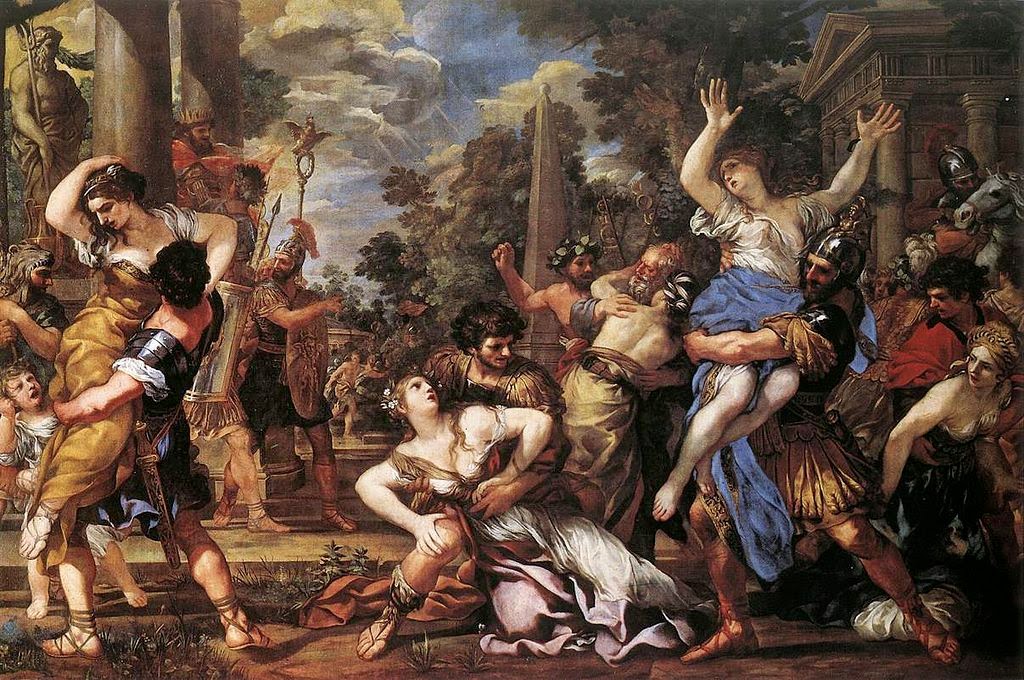
Rape of the Sabine Women by Pietro da Cortona
Rome forged one of the greatest Empires that the world had ever seen. Covering the whole Mediterranean and most of Europe, it became a standard of many empire in the future. Its civilization became the envy of many civilization. Its beginnings, however, was shrouded with legends. The famous story of the twins Romulus and Remus was about the foundation of Rome. It was a story of murder. But the legendary story of growth of Rome was equally heinous and barbaric. The legend of the Rape of the Sabine Women was a story of deception, abduction, and off course, rape.

Prohibition, Roman Style: Domitian's Ban of Vineyards

The Triumph of Titus by Sir Lawrence Alma-Tadema.
Emperor Vespasian in the front, followed by Domitian
and his wife, then Titus at the back.
The Roman Empire dominated western civilization for centuries. At its height, during the period known as Pax Romana, its legions marched across the European continent to the reaches of modern day Spain in the west, Asia Minor and the Middle East in the East, to modern day Britain in the north, and crossing the Mediterranean Sea to the whole North Africa in the south. Its dominion controlled the whole Mediterranean basin for hundreds of years. With wealth and power, essentials became cheap and luxury goods became affordable. Among this luxury was wine.

Justinian Plague: The Declined of the Byzantines

Emperor Justinian
Two major civilization declined and fell in the hands of vicious plagues. Athens, the center of learning and culture of the ancient world, fell in the hands of the Great Athenian Plague. It led to the eventual collapse of the most powerful city-state in the region. Then in the 2nd century CE, the glorious and peaceful period of Rome, dubbed as Pax Romana, ended with the deaths caused by another plague, the Antonine Plague. Almost four centuries after the spread of the Antonine Plague, another Empire was on the brink of either glory or the abyss, the Byzantine Empire. And with an ambitious Emperor in the throne, the Justinian Plague would decide the destiny of a revival of the glory that was Rome.

Antonine Plague:The End of Pax Romana

Galen
The period of Pax Romana lasted for over a century. Spanning over the reign of the Five Good Emperors, it was a period of prosperity, peace, and expansion for the Roman civilization. But during the reign of the last of the Five Good Emperors, Marcus Aurelius, calamity struck the Empire. Even more deadly than a barbarian invasion, a disease spread like wild fire across Rome. The disease was known as the Antonine Plague, the plague that would end peace and tranquility of Rome.

Popular Posts This Week