
Showing posts with label Italy. Show all posts
Showing posts with label Italy. Show all posts
Who was Pope Leo III?
How Great was Charlemagne?

Charlemagne or Charles the Great in French became a legendary icon for Europe. Even being dubbed as "Father of Europe," many countries credit him for setting their roots. But what made Charlemagne the Great?
Roads in History: Roman Empire
 |
The Roman Empire
was the prominent superpower in Europe for more than half a millennium. It
lands encompassed the coastlines of the whole Mediterranean Sea and towards
north covering half of the British Isles. To connect such a massive empire
resulted to the creation of one of the best known road networks in history.
Roads had been a way to connect lands, kingdoms, and empires. It brought great
benefits to civilizations that created such networks. And one of the first
well-known civilizations to use roads in a massive scale was the Roman Empire.
Rape of the Sabine Women: The Growth of Rome
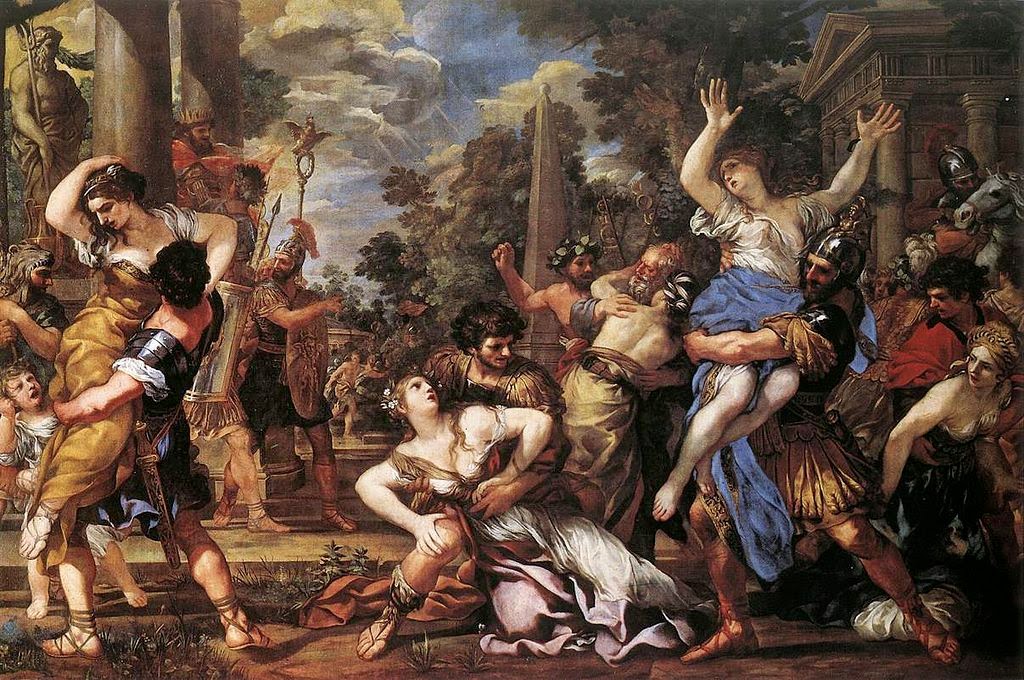 |
| Rape of the Sabine Women by Pietro da Cortona |
Antonine Plague:The End of Pax Romana
 |
| Galen |
The period of Pax Romana
lasted for over a century. Spanning over the reign of the Five Good Emperors,
it was a period of prosperity, peace, and expansion for the Roman civilization.
But during the reign of the last of the Five Good Emperors, Marcus Aurelius,
calamity struck the Empire. Even more deadly than a barbarian invasion, a
disease spread like wild fire across Rome. The disease was known as the
Antonine Plague, the plague that would end peace and tranquility of Rome.
Stories of Ice Cream: Italians
 |
| Remorse of Emperor Nero by John William Waterhouse |
Every summer, the scorching
is always a torture. Sweat pouring down in your head and in your body. Thirst unquenched.
People do drastic things to remain cool, facing air conditioner, fanning
oneself vigorously, etc. But one thing that people would search is a treat that
help to ease the heat. And there noting more than ice cream. A dairy product
with mixed with different flavors that cools the body. However, it is such a
surprise that this summer time treat has a shrouded history. In stories the
Italians were widely credited for its creation.
Holy League: The Victors of Lepanto
 |
| Battle of Lepanto (by Juan Luna) |
Florin: Medieval Age Euro
 |
| The famous landmark of Florence, the Duomo, or the Basilica di Santa Maria del Fiore |
Menelik II: Ethiopian Independence and Modernization
 |
| Menelik II |
In 1885, the Berlin Conference
resulted to the infamous Scramble for Africa. European imperialism devoured all
of Africa. Even a tiny European state, like Belgium, acquired territories in
the African continent larger than their own. However, in the Horn of Africa,
one Kingdom stand tall among others. Abyssinia (modern day Ethiopia) managed to
defend itself from the clutches of the Europeans. Credited of this defense was
the modernization efforts of its ruler – Menelik II.
How a Pope Spread Coffee to the World?
 |
| Pope Clement VIII |
Mussolini's Battles: The Battle for Births

During the 1920’s to 30’s Italian politics was dominated by the National Fascist Party. The party promoted far right wing ideology and led by a charismatic and though World War I veteran Benito Mussolini. Four years into his leadership of Italy, he commenced series of economic battles to address certain issue in the economy. First was the Battle of Grain which was followed by the Battle for the Lira. In 1927, he launched another battle – the Battle for Births.
Mussolini's Battles: The Battle for Lira
 |
| Mussolini (center) in 1922 |
In 1922, the Europe was still recovering
from the horrors and devastation of World War I. The huge casualties caused a
huge drain to manpower. It also destroyed a lot of farms and factories. In
addition, many countries were in debt which was caused by the huge money needed
to wage the war. The pressure to repair the economy and rejuvenate their
country fell to the leaders of the post war period. Some governments, however,
failed to bring this needed boost and recovery to their people. This failure
caused their fall. In Germany, the monarchy under Wilhelm II fell in the hands
of Republicans. In Italy, the reins of power came under the hands of a new far
right wing party – the fascist. They were led by a World War I veteran and die
hard fascist named Benito Mussolini. He would instigate series of economic
battles, among this battles was the Battle for the Lira.
Mussolini's Battles: The Battle for Grain
 |
| A propaganda poster where Mussolini stands in a tractor |
Bodyguards of the Pope: The Swiss Guards
 |
| Swiss Guards |
On Sunday, April 28, 2014, Pope Francis would unveil the two new
saints of the Catholic Church – Pope John Paul II and Pope John XXIII. The St.
Peter’s Basilica would surely be crowded by the by thousands of faithful,
waiting to see personally the announcement of the two new saints. Pope Francis
would be the head of this ritual. And when the Pope expose himself to the
crowds of people in the Vatican City, a group of colorfully dressed men with
morions for a head gear with feathers would be seen standing near to the Pope.
De Medici and French Cuisine
 |
| Catherine de Medici |
The French Cuisine is
characterize by many as classy and full of finest. The story of Francois Vatel exemplified the dedication of the men of the past for their profession. But the
high quality of the French cuisine was, according from many, began during the 16th
century. It was said that an Italian girl brought the characteristic of fine
dining and new ingredients to the French Kingdom.
April Fools' and Gregorian Calendar
 |
| Pope Gregory XIII |
April Fools' is a day in the
year where jokes and hoaxes spread widely. It becomes a trending topic in
Twitter in April 1. But April fools origin could be traced back to the 16th
century.
Canals and Glasses: Glass Industry of the Republic of Venice
 |
| Murano Island |
Gonzalo de Cordoba: Revolutionizing Warfare
 |
| Gonzalo Fernandez de Cordoba |
The 16th century saw
many changes in world history. New continents found. New ideas spread. Era of
Henry VIII, Leonardo Da Vinci, and many more became well known during this
century. Along with new lands and new ideas, a new weapon was crafted that
would change the world forever – the gun. It revolutionized warfare, but during
the 16th century it was in its infancy. Many was still dumbfounded
of its capability. But one country managed to found its potential and used it,
the country of Spain.
Subscribe to:
Posts (Atom)
Popular Posts This Week
-
.jpg) Empire of Ghana West Africa saw the rise of powerful and very wealthy kingdoms and even empire. Various terrain and environment exis...
Empire of Ghana West Africa saw the rise of powerful and very wealthy kingdoms and even empire. Various terrain and environment exis... -
.JPG) BASF Factory (1881) She emerged as the most industrialized country by the end of the 19th century. Germany surpassed the home of the i...
BASF Factory (1881) She emerged as the most industrialized country by the end of the 19th century. Germany surpassed the home of the i... -
 Babur The Taj Mahal, symbol of the wealth and affluence of the Mughal Empire. Built by many workers for many years. Workers are fed fr...
 -
.jpg) Great Britain and France – a rivalry that ran for more than a half a millennium, but in the quest for industrial revolution, unfortunatel...
Great Britain and France – a rivalry that ran for more than a half a millennium, but in the quest for industrial revolution, unfortunatel... -
 John Cockerill The industrial revolution changed the world. It caused a shift from people relying on farming in the countryside to wor...