 |
| Battle of Lepanto (by Juan Luna) |
Showing posts with label Groupings. Show all posts
Showing posts with label Groupings. Show all posts
Holy League: The Victors of Lepanto
Schmalkaldic League
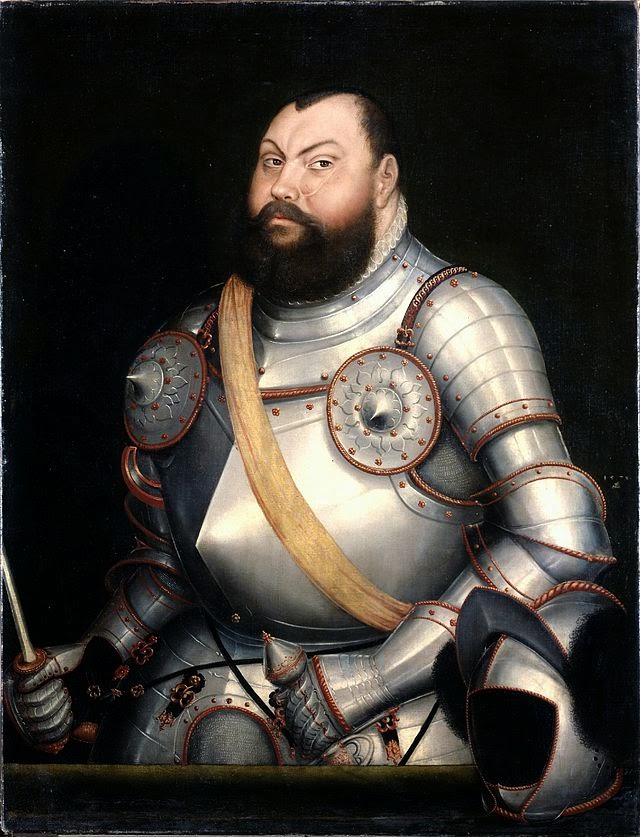 |
| John Frederick of Saxony |
In
a period of chaos and division, small nation came to together to form a strong
defense alliance that would aim in protecting their interest, this was the
condition of the 1500’s Holy Roman Empire. The Holy Roman Emperor aimed in
securing his imperial rule and the imposition of his Catholic ideals. A group
of small Protestant states feared there demise. And as a result, they formed an
alliance that would be known as the Schmalkaldic League.
Swabian League
 |
| Augsburg (1493) |
There was no Germany during
the Medieval Ages, but there were German states. After the death of Charlemagne
in 814, the Holy Roman Empire had politically disintegrated rapidly into
several entities. Some became virtual independent duchies and city states. In
order to maintain independent but with a credible defense, forming alliances
was the most practical way. In the north, the Hanseatic League provided this
defense alongside commercial prosperity. In the region of Swabia a same
alliance was form – the Swabian League.
German Customs Union - Zollverein
 |
| Proclamation of Wilhelm I as Emperor of the German Empire |
Palace
of Versailles, 1871 – Prussian King Wilhelm I was proclaimed the first Kaiser
of the new united German Empire. After a decade of fighting, finally, Prussia
succeeded in unifying a long time divided nation. Unification was indeed
brought by “blood and iron.” But unification seem to had been brought closer by
economic ties brought decades before the pronouncement the German Reich in
Versailles. Similar to the Hanseatic League of the Medieval Ages, the
Zollverein brought economic unity between numerous German States.
The
Zollverein was a customs union formed by several German States during the 19th
century. This meant that trade between members states were free and liberal.
Alongside, a uniform customs policy would also be enacted by its members. Its
economic implication brought energy in trade and ushered the rise of industrial
Germany. But perhaps its political implication, it allowed Prussia to prepare
for its conquests to unify all of Germany.
The
Zollverein began during the early 1800’s when the idea of free trade began to
spread to mainland Europe. During the time of the Napoleonic Wars, several
German state began to liberalized and stimulate their local trade by abolishing
internal tariffs. Internal tariffs involved the payment of a certain percentage
of the price of a product once in crossed a region of the state. This caused
for distribution of local goods to slump and dragged down the rise of local
products. Many states saw the hindrance of local tariffs and one by one, some
states began to abolish this system. In 1807, Bavaria abolished its internal
tariffs. A year later, Wurttemberg followed and then four years later, the
German state of Baden removed it as well.
However,
the most celebrated abolishing of internal tariff was made in May 1818, when
the leading German Kingdom of Prussia decided to abolish its internal tariffs.
But what made the Prussia’s decision was also incorporating free trade with
its neighboring German states. Many
intellectuals welcomed and rejoiced upon the decision of Prussia. The famous
German economist Friedrich von List that promoted free trade hailed the
decision. Also, the Finance Minister of Prussia, Friedrich von Motz, supported
the idea of free trade among German states and even played a role to the formal
creation of the Zollverein in 1833.
Prussia
welcomed and invited some of the German states to join their customs union
during the 1820’s. Some took notice of the promise of prosperity and vibrant
state if they joined Prussia. Some were harassed by Prussia in order to join
their customs union. Infrastructure development was offered by Prussian
diplomats to other German states to persuade them to join. Little by little,
other German states joined Prussia.
In
the 1820’s other German states decided to form their own customs union to
compete with the of Prussia. In 1820 a customs union was attempted to be formed
by the German states of Wurttemberg, Baden, Bavaria, Hesse-Darmstadt, and some
Thuringian states. The negotiations went into deadlock. But the idea of a
separate customs union was still sought by Wurttemberg and Bavaria and
proceeded with the negotiations for the formation of the Southern German
Zollverein in 1828. At the central region of Germany, another customs union was
formed. The German states of Hanover, Brunswick, Nassau, and Hesse-Darmstadt
decided to form their own Central German Trade Union in 1828 also.
Eventually,
Prussia wanted to expand its customs union as it also meant prestige and economic
growth for the Kingdom. Negotiations for the merging of the three unions, from
1828, underwent with the two other customs union. In 1829, a Prussian
Zollverein and the Southern German Zollverein concluded a trade treaty. It was
a first step towards the final combination of the three Zollverein in 1833. The
Deutscher Zollverein was finally established. However, there remained some
resistance from Prussian economic aggression. Hanover, Brunswick and Oldenburg
ceded from the Central German Union in order to form their separate customs
union – the Steuerverein. The resistance of the Steuerverein continued for
several decades. Other little German states had no match for Prussia and its
Zollverein and decided to join. By 1840’s, twenty eight out of thirty four
German States were members of the Zollverein. A decade later, being surrounded
and isolated by the Zollverein, the Steuerverein surrendered and in 1854 it
joined the Zollverein.
The
Zollverein created a huge common market at the center of Europe. It orchestrated
infrastructure development through its members, including roads and railways.
It fostered future industrialization. Trade was promoted through the
establishment of a uniform currency based on the Prussian Taler during the
1850’s. Standards of weight and measurements were issued.
Prussia
utilized the Zollverein into its political ambitions. During the early years of
the Zollverein, Austria as part of the union was being discussed in Vienna. The
chancellor, Metternich, was hesitant to the membership of Austria. Under
economic implication, Austria could be placed under the influence of Prussia
that used its currency as the most widely used in the union. For political
implication, Austria joining the Zollverein meant that it was conceding to
Berlin in the leadership race of Germany. So Austria never joined the
Zollverein.
Meanwhile,
in Berlin, Chancellor Otto von Bismarck used the Zollverein in unifying
Germany. He saw that economic integration was important for political
integration to follow. He also saw the Zollverein as a way to influence other
German states into recognizing Prussia as the future leader of a unified
Germany.
In
1871, after the Franco-Prussian War, the German Empire was proclaimed. Many
German states were hesitant in being part of the empire and losing their identity
and their sovereignty. So an imperial and centralized government had to come
slowly. Alongside political autonomy still being retained, some economic
autonomy was also given. Thus, the Zollverein continued to flourish even under
the period of Imperial Germany.
The customs union Zollverein would remain existent until the early
20th century. It would then meet its end as the Great War
became unfavorable for imperial Germany. Alas, after the signing
of the treaty of Versailles, the monarchy of Wilhelm II was deposed, along
with him was the dissolution of the Zollverein.
See also:
Delian League: The Athenian Empire
Hanseatic League: Economic Group of Germany
Holy League: The Victors of Lepanto
Kalmar Union
Schmalkaldic League
Swabian League
Bibliography:
Delian League: The Athenian Empire
Hanseatic League: Economic Group of Germany
Holy League: The Victors of Lepanto
Kalmar Union
Schmalkaldic League
Swabian League
Bibliography:
Anmer, C. & D. Anmer. Dictionary of Business and Economics.
New York: The Free Press, 1984.
Hodge, C. (ed.). Encyclopedia of the Age of Imperialism, 1800 – 1914. Connecticut: Greenwood Press, 2008.
Kitchen, M. A History of Modern Germany: 1800 to the Present. Maryland: Wiley-Blackwell, 2012.
Hodge, C. (ed.). Encyclopedia of the Age of Imperialism, 1800 – 1914. Connecticut: Greenwood Press, 2008.
Kitchen, M. A History of Modern Germany: 1800 to the Present. Maryland: Wiley-Blackwell, 2012.
Kalmar Union
 |
| Queen Margaret |
Hanseatic League: Economic Group of Germany
 |
| Lübeck - center of the Hanse |
A united German States was not formed until the establishment of
the German Empire in 1871 under the leader of Prussia, its King Wilhelm I, and
its brilliant Chancellor, Otto von Bismarck. In present Germany before the
1871, several small German states were established and ruled by local princes.
During the Middle Ages, the Holy Roman Empire existed under the control of the
Germans, but the Empire was fragmented by Princes who owned lands and treated
it like their own smaller kingdom. The closest form of united Germany was a
mercantile organization known as the Hanseatic League or otherwise known as
Hanse.
Delian League: The Athenian Empire
 |
| Parthenon by Lusieri Giovannia Battista |
Subscribe to:
Posts (Atom)
Popular Posts This Week
-
.jpg) Great Britain and France – a rivalry that ran for more than a half a millennium, but in the quest for industrial revolution, unfortunatel...
Great Britain and France – a rivalry that ran for more than a half a millennium, but in the quest for industrial revolution, unfortunatel... -
 Emperor Meiji Japan’s independence came under threat from the increasing presence of westerners in Asia. In 1858, the ships of Ameri...
 -
 Bessemer Converter A process that change the world. It added steam to the already ongoing industrial revolution that hit the world. It...
 -
.JPG) BASF Factory (1881) She emerged as the most industrialized country by the end of the 19th century. Germany surpassed the home of the i...
BASF Factory (1881) She emerged as the most industrialized country by the end of the 19th century. Germany surpassed the home of the i... -
 Babur The Taj Mahal, symbol of the wealth and affluence of the Mughal Empire. Built by many workers for many years. Workers are fed fr...